/ Conversation
Judy Davis finds the humour in Helen Garner’s quietly seething protagonist in Belvoir’s ‘The Spare Room’
Judy Davis brings intensity to Garner’s The Spare Room: by Kath Kenny in The Saturday Paper, 18 June 2025
In 1977, Helen Garner’s first novel, Monkey Grip, was released and Judy Davis made her film debut in the road-trip comedy High Rolling (Davis’s star-making role as Sybylla, in Gillian Armstrong’s adaptation of Miles Franklin’s novel, My Brilliant Career, came two years later). The careers of these women in Australian literary and film culture have run in parallel ever since, but they’ve also circled each other. Before Monkey Grip, Garner acted on Melbourne’s Pram Factory stage and played a fast-talking speed addict in the 1975 indie film Pure Shit. Armstrong directed the 1992 The Last Days of Chez Nous, Garner’s screenplay about sisters in a love triangle.
When Belvoir St Theatre’s Eamon Flack decided to adapt Garner’s novel The Spare Room, Davis must have been the obvious choice to play Helen, Garner’s fictional surrogate, a thrice-divorced Melbourne woman living next door to her daughter and grandchildren who spends three weeks caring for a dying friend from Sydney.
The play opens with an uncanny hall-of-mirrors effect: Davis playing the fictional Helen, who closely resembles the author named Helen.
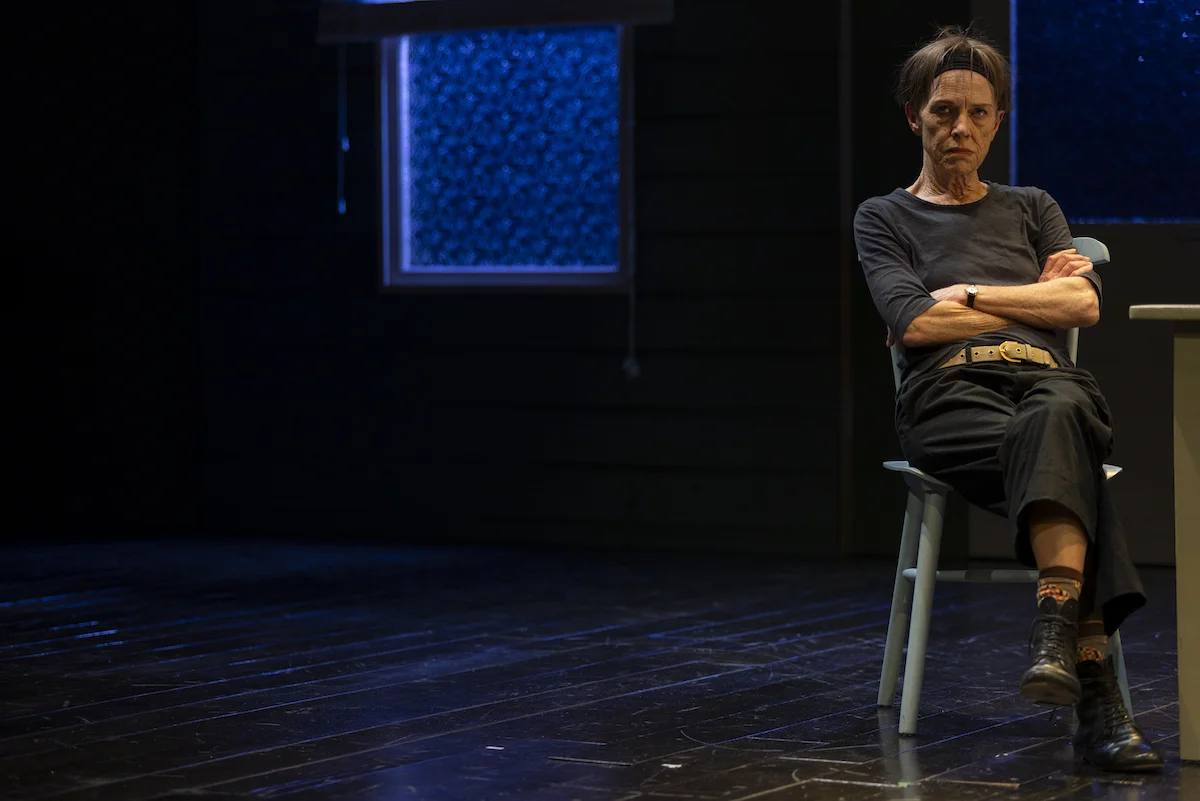
The performance begins with a long monologue of exposition, but once the action begins, Davis begins to inhabit the stage and Helen. Her Helen – black clad, flat shoes and short, blunt hair, is all tightly wound efficiency. She neurotically scans for potential disasters. Her Melbourne cottage has a solid, stark simplicity – no mouldings and no excess (Mel Page’s set design and Paul Jackson’s lighting swiftly transform the scene to a bar or waiting room). Helen fluffs pillows and judiciously adds comfort: flowers, fresh sheets and floral quilt, a bedside lamp.
At first glance, Nicola (Elizabeth Alexander, appearing as if manifested directly from Garner’s page) is Helen’s opposite: blonde mane, decked in girlish pink, barely walking when she arrives. More than a little posh, she calls Helen “Darling”.
Helen calls Nicola “Duchess” and becomes Nicola’s servant as her friend embarks on a series of vitamin C injections, ozone saunas and coffee enemas that are supposed to blast her cancer away in three weeks. But Helen’s servitude – the nights washing sweat-soaked sheets, the bicycling to fetch lemonade – has strict limits: she has a ticket to Vienna in December. In the meantime, she’ll play court jester, humouring Nicola’s follies and cracking jokes, while also being the one to call “bullshit”, who wants her friend to “get real”.
While Nicola wears a permanent rictus smile, Helen admits her default mode is “angry”. The role she most seems to relish is self-appointed: that of Nicola’s soldier. She goes into battle with guns aimed and knives raised at the cranks Nicola has fallen in with at the Theodore Institute, where the staff are like former holiday timeshare salespeople who have read a couple of wellness books. Helen is horrified at Nicola’s cooing over the institute’s PowerPoint presentation. If stress really is the No. 1 cause of cancer, as one “specialist” tells them, surely the one-woman cortisol factory that is Helen would have died long ago.
You could say that if Nicola is fiction, Helen is nonfiction. But it’s not that simple. Just as Garner’s work across the two modes has always been a productively happy collaboration and collusion, the two friends are drawn together because they see something in the other that they themselves lack. Helen admires Nicola’s generosity, her style and Pollyanna-like ability to see wonder in the everyday. She built a romantic home, an eyrie on the shores of Pittwater accessible only by boat, one she’s now too ill to return to. Nicola, in turn, is drawn to Helen’s clear-eyed pragmatism and the rich family life she has created. A psychiatrist friend (Alan Dukes) tells Helen that perhaps Nicola wants her to be the one to tell her she is “going to die”.
The play reproduces the key scenes from Garner’s novella-length work, including Nicola’s excruciating rounds of treatment, and trips to the Western doctors Helen insists upon. Emma Diaz, as Nicola’s niece Iris, beautifully brings light and air to the tension between the two friends: her arrival as reinforcement leaves Helen prostrate with gratitude. A slower scene, in which Nicola drops her smile and the two friends finally get real, provides a grace note too.
Garner fans will delight in spotting some sampling from other works, including a pivotal scene from the last instalment of her diaries, How to End a Story. Some nuances are lost in the translation to the stage, however – crucially, Helen’s own propensity for belief. When Helen, Nicola and Iris attend a magic show, in the stage version Helen and Iris sit among the Belvoir audience. The magician (Alan Dukes again) brings a wide-eyed Nicola centre stage. She’s his volunteer as he makes balls disappear as fast as the Theodore Institute promises to banish her cancer. The scene is played as if to underline and make bold Nicola’s childlike credulity. In the book, the scene is described through Helen’s eyes: “There must be an explanation for everything he did. But I don’t want to know what it was.” She wants to believe in magic too.
While the novella is punctuated with black humour, the stage allows for more slapstick moments (and one very funny sight gag). Davis is particularly skilled at finding the laughs and, in a nearly two-hour performance with no interval, they’re a gracious concession to a live audience.
Dukes plays five different medical men, from the Theodore shonks to Australia’s “greatest neurosurgeon”. While the medicos are wildly different in qualifications and stature, they read (confusingly, at times) as variations of the same character: professionally abstract and even perfunctory. Professor Theodore is so lacklustre it’s hard to understand even desperate Nicola’s faith. Perhaps these portrayals are the point. Whether she’s consulting Western medicine or cooked pseudoscience, Nicola is as much of a guinea pig as the pets that roam Helen’s daughter’s house next door. “You want the titanium implant,” a top neurosurgeon tells her, and she replies as if hypnotised, “I want the titanium.” Is he just upselling?
If Garner’s early works were about sex and how to become someone, about how to juggle love and career, The Spare Room is about how to face no longer being someone in the world and asking what all that love and work meant. Helen wants to insist Nicola’s life hasn’t been wasted, while also insisting she not waste her final days and dollars tilting at windmills.
Garner’s work has always been drawn to subjects like death and how we care (and don’t care) for loved ones, from Nora’s love for a junkie with a death wish in Monkey Grip, to a mother’s complicated love and rage at a dependent child in The Children’s Bach, and the lovers and parents with murderous intents in her true crime books. She’s interested in saintly people and people full of fury, but she’s really interested in how we can be both types of people all at once. Davis’s and Flack’s Belvoir production is a fine tribute to her project.